| ID |
Date |
Author |
Topic |
Subject |
|
2685
|
24 Jan 2024 |
Pavel Murat | Bug Report | Warnings about ODB keys that haven't been touched for 10+ years |
I don't immediately see a reason for saying that if a DB key is older than 10 yrs, it may not be valid.

However, it would be worth learning what was the logic behind choosing 10 yrs as a threshold.
If 10 is just a more or less arbitrary number, changing 10 --> 100 seems to be the way to go.

-- regards, Pasha |
|
2688
|
28 Jan 2024 |
Konstantin Olchanski | Bug Report | Warnings about ODB keys that haven't been touched for 10+ years |
> I don't immediately see a reason for saying that if a DB key is older than 10 yrs, it may not be valid.
>
> However, it would be worth learning what was the logic behind choosing 10 yrs as a threshold.
> If 10 is just a more or less arbitrary number, changing 10 --> 100 seems to be the way to go.

Please run "git blame" to find out who added that check.

If I remember right, it was added to complain/correct dates in the future.

I think the oldest experiment at TRIUMF where we still can load an odb into current MIDAS is TWIST,
now about 25 years old. the purpose of loading odb would be to test the history function
to see if we can look at 10-15 year old histories. (TWIST history is in the latest FILE format,
so it will load).

I think this age check should be removed, but there must be *some* check for invalid/bogus timestamps. Or
not, we should check if MIDAS cares about timestamps at all, if ODB functions never use/look at timestamp,
maybe we are okey with bogus timestamps. They may look funny in the odb editor, but that's it.

K.O. |
|
2695
|
29 Jan 2024 |
Stefan Ritt | Bug Report | Warnings about ODB keys that haven't been touched for 10+ years |
> Please run "git blame" to find out who added that check.

OK ok, was me. But actually 2003. I hope that this being more than 20y ago excuses me not remembering it ;-)

> I think this age check should be removed, but there must be *some* check for invalid/bogus timestamps. Or
> not, we should check if MIDAS cares about timestamps at all, if ODB functions never use/look at timestamp,
> maybe we are okey with bogus timestamps. They may look funny in the odb editor, but that's it.

I changed the code to only check for timestamps more than 1h in the future and then complain. This should
avoid glitches when switching daylight savings time.

Stefan |
|
2882
|
28 Oct 2024 |
Lukas Gerritzen | Bug Report | Visual glitch in history system |
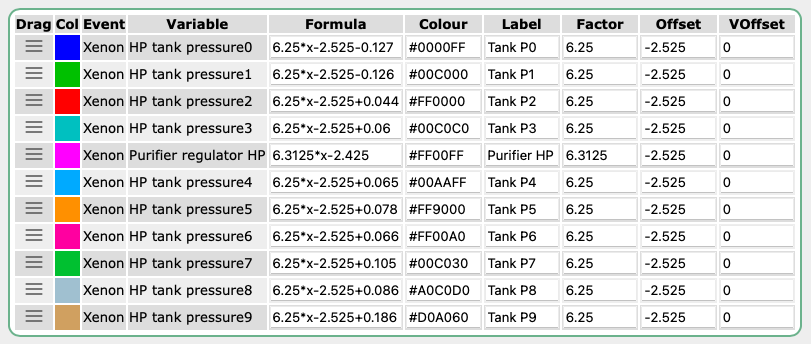
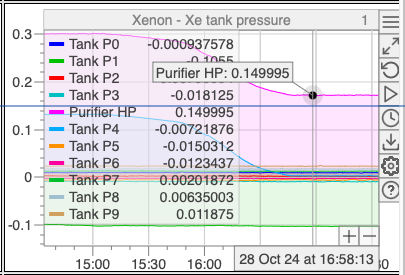
Today, I encountered the bug shown in the attached video. The value of the plotted curve does not match the mouseover number.

When trying to understand it better, I stopped being able to replicate. Has anyone else observed a similar problem? |
| Attachment 1: Screen_Recording_2024-10-28_at_17.23.57.mov
|
| Attachment 2: Screenshot_2024-10-28_at_17.29.34.png
|
|
|
Draft
|
28 Oct 2024 |
Lukas Gerritzen | Bug Report | Visual glitch in history system |
|
| Attachment 1: Screenshot_2024-10-28_at_17.34.26.png
|
|
|
17
|
09 Jul 2004 |
Stefan Ritt | | Version 1.9.4 released today |
Version 1.9.4 of midas has been released today. It is mainly a maintenance
update, for all the little things which have been fixed since the last
release, and does not contain major new functionality. |
|
612
|
04 Aug 2009 |
Exaos Lee | Forum | VME-related codes contribution |
Hi, all
I have some codes while using MIDAS. I upload them here. They are tested with
SIS3100. I haven't other VME controllers, so I don't know whether they work with
other controllers. I just hope that they are helpful. You may find information
from the file "00README.txt" in the package vme4midas.zip. My English is limited, I just hope
that you may catch my ideas. 
All my best.
Exaos Lee |
| Attachment 1: vme4midas.zip
|
|
2078
|
21 Jan 2021 |
Thomas Lindner | Info | Using external ELOG with newer mhttpd |
A warning, in case others have the same problem I had.

In the past you could configure mhttpd so that the 'Elog' button would redirect to an external ELOG server; to do this you only needed to create and set the ODB variable '/Elog/URL' to the URL of your external ELOG server.

But with the newer MIDAS you need to set two ODB variables:

* "/Elog/URL" needs to be set to the URL of the external ELOG.
* "/Elog/External Elog" needs to be set to 'y'

I hadn't noticed this and was confused why my Elog button wasn't working after upgrading MIDAS.

MIDAS documentation was updated to reflect this change:

https://midas.triumf.ca/MidasWiki/index.php/Electronic_Logbook_(ELOG) |
|
2114
|
01 Mar 2021 |
Marius Koeppel | Forum | Using JSROOT.openFile with Midas |
Hi everyone,

I am currently trying to access a ROOT file produced by manalyzer. By calling JSROOT.openFile("MIDAS_DOMAIN/outputRUN.root"). I can download the rootfile via MIDAS_DOMAIN/outputRUN.root. Using JSROOT.openFile results in an 501 error,
since the request feature is not provided. Using a simple API and uploading outputRUN.root there worked fine (when the run finised).

Is there a way to use JSROOT.openFile with the current analyzed root file in Midas (so during the run)? I know that one can access histograms of the THttpServer via JSON but I need to get the full root tree.

Cheers,
Marius |
|
2118
|
03 Mar 2021 |
Konstantin Olchanski | Forum | Using JSROOT.openFile with Midas |
>
> I am currently trying to access a ROOT file produced by manalyzer. By calling JSROOT.openFile("MIDAS_DOMAIN/outputRUN.root"). I can download the rootfile via MIDAS_DOMAIN/outputRUN.root. Using JSROOT.openFile results in an 501 error,
> since the request feature is not provided. Using a simple API and uploading outputRUN.root there worked fine (when the run finised).
>
> Is there a way to use JSROOT.openFile with the current analyzed root file in Midas (so during the run)? I know that one can access histograms of the THttpServer via JSON but I need to get the full root tree.
>

Good questions. Right now in manalyzer I do not do anything more than starting the ROOT web server (so whatever
they support should work) and providing two "standard" location: one in the output file for histograms
and other permanent output and one in memory for transient objects, such as waveform plots, etc.

At some point I would like to provide a function to "get" TAFlowEvent objects so you can do things
like event displays in javascript. But I need a c++ to json serializer and standard c++ does not have it.
So I will have to use the clang serializer (also used by ROOT) and it will take me a few days
to figure it out.

Back to "openFile".

If you figure out the missing bits that need to be added to our code,
please post them here or submit them as a pull request or a bug report in bitbucket.

Also it would be good if you can provide a code example of "openFile" working elsewhere
but not with manalyzer, if I can run it, maybe I can figure out what's missing. But lacking
some example code, there is nothing for me to hack at.

K.O. |
|
2120
|
04 Mar 2021 |
Marius Koeppel | Forum | Using JSROOT.openFile with Midas |
Thank you for the answer :)

> At some point I would like to provide a function to "get" TAFlowEvent objects so you can do things
> like event displays in javascript. But I need a c++ to json serializer and standard c++ does not have it.
> So I will have to use the clang serializer (also used by ROOT) and it will take me a few days
> to figure it out.

That sounds exactly what I was searching for. Because I wanted to create an interface between rootana and
an event display build in javascript. Since all I tried did not really worked with the current rootana
I have now a "solution". I use the MIDAS python client, read directly events from the MIDAS buffer and provided
the events in a JSON format with the python flask API. Since the rendering of the event display is the bottleneck
and I only need a view events to display this solution worked really well for me. Maybe having such a JSON API of
the event buffer in MIDAS directly would also work for most of the event display applications or other simple javescript
applications (my opinion).

> If you figure out the missing bits that need to be added to our code,
> please post them here or submit them as a pull request or a bug report in bitbucket.

One of the problems I had was the CORS domain of the THttpServer. In manalyzer:1894 you do
sprintf(str, "http:127.0.0.1:%d", httpPort); but there are additional options for the THttpServer (like "?cors=DOMAIN").
So maybe a flag while starting manalyzer passing such options would be nice. I will create a pull request passing them later.

> Also it would be good if you can provide a code example of "openFile" working elsewhere
> but not with manalyzer, if I can run it, maybe I can figure out what's missing. But lacking
> some example code, there is nothing for me to hack at.

The problem is that it was not even running on simple THttpServer using interactive root:

    serv = new THttpServer("http:8088?cors=*");
    TFile *_file0 = TFile::Open("example_root.root")
    serv->Register("File", _file0);

So I tried just saving the file in the $MIDAS_DIR and tried to use mserver with JSROOT.openFile. I attached the html file and
a test root file.

Cheers,
Marius |
| Attachment 1: test.html
|
| Attachment 2: example_root.root
|
|
2121
|
04 Mar 2021 |
Konstantin Olchanski | Forum | Using JSROOT.openFile with Midas |
well, if this is something in ROOT, perhaps you can pursue it with the ROOT crowd,
they are quite friendly.

on my side, if all you need is to pull event data banks, this is easy to add
in mhttpd.

the jsonrpc request will look something like this:

get_event {
"buffer":"system",
"get_type":"GET_LATEST", (or whatever bm_receive_event() can do)
"include_banks":["AAAA","BBBB"],
"exclude_banks":["CCCC","DDDD"]
}

and return something like this:

event {
"header":{"event_id":1,...},
"banks":{
"AAAA":[1,2,3,4],
"BBBB":NULL (you asked for it, so you always get it, but it is NULL if bank does not exist)
}
}

would this work for what you are doing?

(this is not good enough if data has to be pre-digested by c++ analysis in rootana)

K.O. |
|
Draft
|
04 Mar 2021 |
Stefan Ritt | Forum | Using JSROOT.openFile with Midas |
I also need midas events going back to the |
|
2122
|
04 Mar 2021 |
Stefan Ritt | Forum | Using JSROOT.openFile with Midas |
I also need midas events going back to the browser for single event display, so put +1 for me.

Please also consider to use JavaScript typed arrays instead of JSON. For large midas banks, type
arrays are 5-10 times faster than JSON encoding/decoding.

Best,
Stefan |
|
2124
|
04 Mar 2021 |
Marius Koeppel | Forum | Using JSROOT.openFile with Midas |
> would this work for what you are doing?

Yes, having such a function would be perfect for the applications I have a the moment.

> (this is not good enough if data has to be pre-digested by c++ analysis in rootana)

Also agree, if one wants to have a more sophisticated applications it is definitely needed to preprocess the data.

Cheers,
Marius |
|
283
|
01 Aug 2006 |
Konstantin Olchanski | Bug Fix | User-tunable buffer sizes |
By default, MIDAS creates shared memory event data buffers of default size
EVENT_BUFFER_SIZE defined in midas.h and until now making of large data buffers
for high data rate or large event size experiments was complicated.

Now, bm_open_buffer() will try to read the event buffer size from ODB. If
"/Experiment/Buffer Sizes/BUFFER_NAME" of type DWORD exists, it's value is used
as the buffer size, overriding the default value.

For example, to increase the size of the default MIDAS event buffer ("SYSTEM")
to 2000000 bytes, shutdown all MIDAS programs, delete the old .SYSTEM.SHM file
(and the shared memory segment, using ipcrm). Then run odbedit, cd /Experiment,
mkdir "Buffer Sizes", cd "Buffer Sizes", create DWORD SYSTEM, set SYSTEM
2000000. Then start the rest of the MIDAS programs. Check that the buffer has
the correct size by looking at the size of .SYSTEM.SHM and of the shared memory
segment (ipcs).

This method work for all MIDAS buffers, except for ODB, where the size has to be
specified at creation time using the odbedit command "-s" argument.

K.O. |
|
351
|
26 Feb 2007 |
Stefan Ritt | Info | Usage of event channel for improved throughput |
Starting from SVN revision 3642, sending events from the front-end has been revised.
Since long time ago, there is a special TCP socket established between any front-end and the mserver which can be used to bypass the midas RPC layer completely and purely send events. There was a #define USE_EVENT_CHANNEL but to my knowledge nobody used it.
While optimizing data throughput for the MEG experiment, I revisited this mechanism and got it finally working. Here are some benchmark tests made with the produce program on two dual-CPU machines running on Gigabit Ethernet:
Using normal RPC socket:
event size    speed [MB/sec] CPU usage front-end  CPU usage server
==================================================================
    40          3            22                   100
  1000         44            25                   100
100000        101            14                    50
Using new event socket:
event size    speed [MB/sec] CPU usage front-end  CPU usage server
==================================================================
    40         12            100                   34
  1000         99            58                    59
100000        101            14                    43
As can be seen, the CPU load on the server drops significantly for smaller events since the processing time per event is reduced. If the transfer was limited by the server, the throughput goes up significantly. For large events the bottleneck on the server side is the memcpy of events, so no big improvement is visible. The saved CPU time however can be used to analyze more events for example.
The event socket is now enabled by default in the front-end by setting
rpc_mode = 1
in mfe.c and should be checked carefully in various experiments. There is a small chance that events get stuck in the buffer cache on the server side at the end of the run, in which case they would show up as the first events of the next run. I know that this problem happened in some experiment before, but that must have been unrelated to the rpc_mode. So please check again and report any problem with the new rpc_mode. |
|
884
|
07 May 2013 |
Konstantin Olchanski | Info | Updated: javascript custom page examples |
I updated the MIDAS javascript examples in examples/javascript1. All existing mhttpd.js functions are
now exampled. (yes).

Here is the full list of functions, with notes:

ODBSet(path, value, pwdname);
ODBGet(path, format, defval, len, type);
ODBMGet(paths, callback, formats); --- doc incomplete - no example of callback() use
ODBGetRecord(path);
ODBExtractRecord(record, key);
new ODBKey(path); --- doc incomplete, wrong - one has to use "new ODBKey" - last_used was added.
ODBCopy(path, format); -- no doc
ODBRpc_rev0(name, rpc, args); --- doc refer to example
ODBRpc_rev1(name, rpc, max_reply_length, args); --- same
ODBGetMsg(n);
ODBGenerateMsg(m);
ODBGetAlarms(); --- no doc
ODBEdit(path); --- undoc - forces page reload

As annotated, the main documentation is partially incomplete and partially wrong (i.e. ODBKey() has to be
invoked as "new ODBKey()"). I hope this will be corrected soon. In the mean time, I recommend that
everybody uses this example as best documentation available.
http://ladd00.triumf.ca/~daqweb/doc/midas/html/RC_mhttpd_custom_js_lib.html

svn rev 5360
K.O. |
|
887
|
10 May 2013 |
Konstantin Olchanski | Info | Updated: javascript custom page examples |
> ODBCopy(path, format); -- no doc

Updated example of ODBCopy:

format="" returns data in traditional ODB save format
format="xml" returns data in XML encoding
format="json" returns data in JSON encoding.

K.O. |
|
120
|
16 Oct 2003 |
David Morris | | Updated thread functions |
ss_thread_create now returns the thread ID on success, and zero on failure.
Previously returned SS_SUCCESS or SS_NO_THREAD. User must now test the
return value to determine result.

ss_thread_kill added to kill the passed thread ID. Returns SS_SUCCESS or
SS_NO_THREAD.

Any thread creation must be verified now, and old code must be examined to
ensure the return value is checked. |